

CukCuk vs Qashier is a comparison many Philippine restaurant owners may consider when choosing a point-of-sale (POS) system. Both platforms offer POS solutions for businesses in the Philippines, but they take different approaches. CukCuk focuses specifically on restaurant management, while Qashier combines POS and integrated payments for restaurants, retail stores, salons, and other businesses.
Choosing the right POS system is one of the most consequential technology decisions a Philippine restaurant owner can make. Your POS affects how quickly servers take orders, how accurately payments are processed, how smoothly orders reach the kitchen, how inventory is tracked, and how easily you can manage multiple outlets.
CukCuk vs. Qashier at a Glance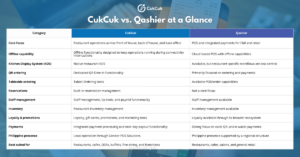
The biggest distinction is straightforward: CukCuk is designed around restaurant operations, while Qashier is designed around POS and payments across several business categories.
A Quick Introduction to CukCuk and Qashier
What Is CukCuk?
CukCuk is a cloud-based restaurant management platform developed by MISA. In the Philippines, it operates through Condor POS Solutions.
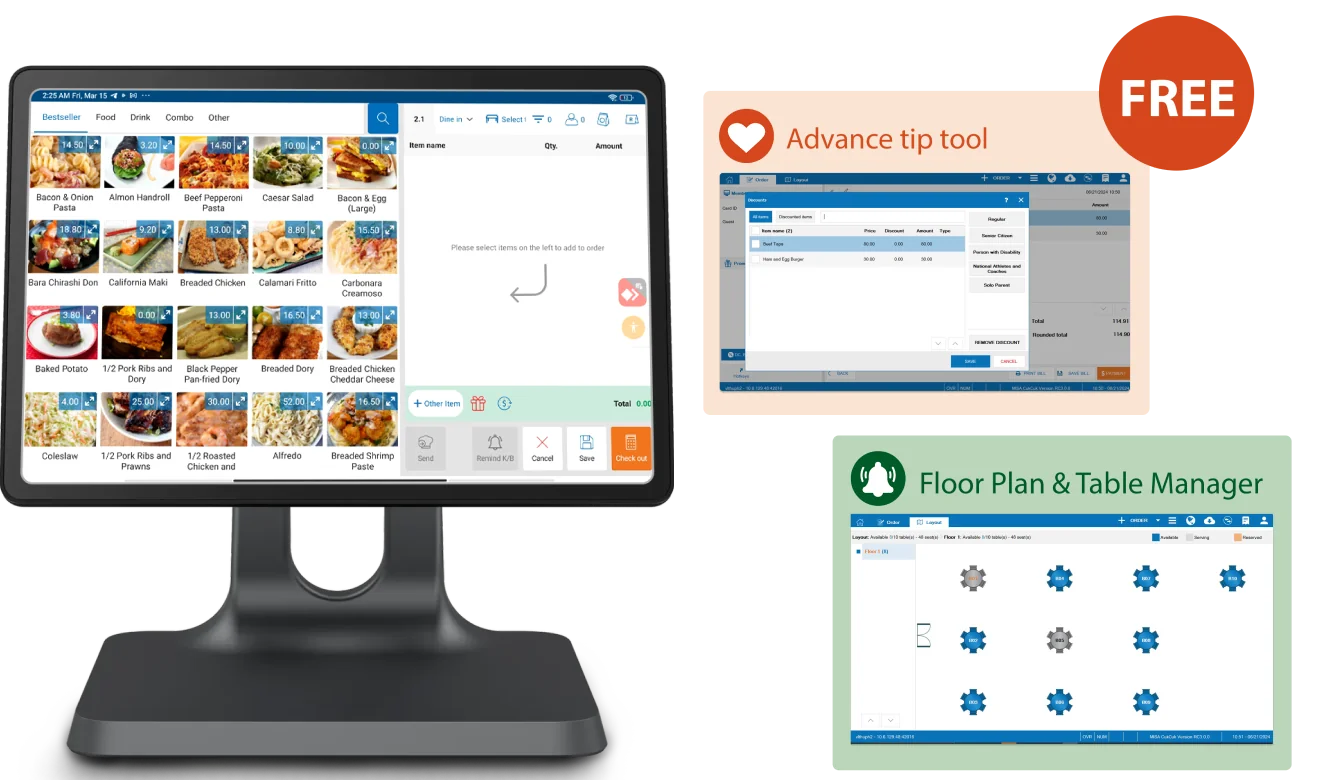
Its product suite is centered on restaurant operations, covering both customer-facing and behind-the-scenes processes.
Depending on the restaurant’s setup, CukCuk can support functions such as:
- POS and order management
- Table and floor management
- QR dine-in ordering
- Tableside tablet ordering
- Kitchen Display System (KDS)
- Inventory management
- Reservation management
- Staff management
- Payroll
- Loyalty programs
- Gift cards
- Promotions and marketing
That makes CukCuk less about simply processing a transaction and more about connecting the different parts of a restaurant’s daily operation.
What Is Qashier?
Qashier is a Singapore-founded POS and payments company launched in 2019. It has expanded across Southeast Asia, including the Philippines, Malaysia, and Thailand.
Unlike a restaurant-only platform, Qashier serves a wider range of businesses, including:
- Restaurants
- Cafes
- Retail stores
- Salons
- Other small and medium-sized businesses
A major part of Qashier’s value proposition is integrated payment acceptance. Businesses can use the platform to manage POS transactions alongside card, QR, and e-wallet payments.
That broader approach can be attractive if your priority is a straightforward POS and payments solution rather than a deeply specialized restaurant management platform.
CukCuk vs. Qashier: Feature-by-Feature Comparison
1. Restaurant-Specific Features
This is where the difference between the two platforms becomes most apparent.
CukCuk is designed around restaurant workflows. Its feature set includes functions such as reservations, QR dine-in ordering, tableside ordering, kitchen display, table management, inventory, and staff management.
For a full-service restaurant, these aren’t isolated features. They form a connected workflow:
Guest arrives → server takes order → order reaches kitchen → kitchen prepares it → payment is processed → inventory is updated → management reviews the transaction.
Qashier can handle restaurant POS and ordering requirements, but its broader positioning means restaurant-specific operational depth is not the sole focus of the platform.
Winner for restaurant-specific workflows: CukCuk
2. Offline POS Reliability
Internet connectivity is an important consideration for Philippine restaurants.
A restaurant can’t simply stop taking orders because its internet connection drops. During peak service, even a short interruption can create confusion between the dining room, cashier, and kitchen.
CukCuk includes offline functionality designed to allow operations to continue when connectivity is interrupted, with data syncing when the connection is restored.
Qashier also offers offline capabilities as part of its cloud-based POS approach.
When comparing the two, restaurant owners should look beyond the word “offline” and ask practical questions:
- What functions continue working without an internet connection?
- Can staff continue taking orders?
- Can payments still be processed?
- How is data synchronized afterward?
- What happens if multiple devices are operating offline?
- What support is available when connectivity problems occur?
Key consideration: Both offer offline capabilities, but test the exact offline workflow against your restaurant’s setup before choosing.
3. Kitchen Display System (KDS)
For restaurants with multiple stations or a busy kitchen, the connection between the front of house and back of house is critical.
CukCuk includes a Kitchen Display System (KDS) as part of its restaurant-oriented product offering. Orders can move digitally from the POS to the kitchen, helping staff organize preparation and reduce reliance on handwritten tickets.
Qashier also provides restaurant functionality, including kitchen-related tools, but kitchen operations are not as central to its overall positioning.
For a restaurant where kitchen coordination is a major concern, a native restaurant KDS can be a significant advantage.
Winner for restaurant-focused kitchen operations: CukCuk
4. QR Dine-In and Tableside Ordering
Digital ordering has become increasingly useful for restaurants looking to reduce wait times and give customers more control over how they order.
CukCuk offers dedicated QR Dine-In and Tablet Ordering products. These can support different service models, from customers scanning a QR code at their table to servers using tablets to take orders.
Qashier also supports ordering and payment workflows, but its broader POS positioning means CukCuk has an advantage if you specifically want restaurant-centric tables and ordering tools.
Winner for restaurant-specific ordering workflows: CukCuk
5. Reservation Management
Reservations can become difficult to manage when restaurants rely on notebooks, spreadsheets, messaging apps, or separate reservation tools.
CukCuk includes a reservation management function, allowing restaurants to incorporate reservations into the wider restaurant management system.
Qashier’s core proposition is more focused on POS and payments, so reservation management is not a central part of the platform.
For restaurants that regularly handle reservations, particularly full-service restaurants, this difference can matter.
Winner for reservations: CukCuk
6. Staff and Payroll Management
A restaurant POS shouldn’t only help you collect payments. It can also become a source of operational data about your team.
CukCuk includes staff management functionality alongside tools such as tip management and payroll.
Qashier also provides staff and business management functionality, but its broader POS-and-payments focus means CukCuk may be a more natural fit for restaurants looking to consolidate operational management.
For restaurant groups with larger teams, it’s worth comparing the details of scheduling, attendance, payroll, permissions, and reporting rather than simply comparing feature names.
Advantage for integrated restaurant staff management: CukCuk
7. Inventory Management
Inventory accuracy directly affects restaurant profitability.
A POS that connects sales with inventory can help managers understand what is being consumed, identify discrepancies, and make better purchasing decisions.
Both CukCuk and Qashier offer inventory-related functionality. The important question is how well those features match your restaurant’s actual inventory model.
A cafe with a relatively small menu may need only basic stock tracking. A multi-outlet restaurant with recipes, ingredients, wastage, transfers, and purchasing requirements will need much deeper inventory capabilities.
Best choice: Depends on the complexity of your inventory operation.
8. Loyalty, Promotions, and Guest Engagement
Getting a customer through the door once is useful. Getting them to return is better.
CukCuk offers tools for customer engagement, including loyalty programs, gift cards, promotions, and marketing functions.
Qashier also supports loyalty through its broader ecosystem.
If customer retention is a priority, compare the platforms based on the specific campaigns you plan to run rather than simply asking whether they have “loyalty.”
For example:
- Can customers earn and redeem points?
- Can you create targeted promotions?
- Can gift cards be managed digitally?
- Can you track customer purchase history?
- Can multiple outlets share customer data?
Advantage for an integrated restaurant marketing stack: CukCuk
Where CukCuk Pulls Ahead for Philippine Restaurants
1. It’s Built Around Restaurant Workflows
The biggest CukCuk advantage is its restaurant-first approach.
A restaurant may need much more than a cash register: reservations, tables, QR ordering, kitchen coordination, inventory, staff management, promotions, and reporting all need to work together.
CukCuk brings those functions into one restaurant management platform.
For a full-service restaurant, that depth can be more valuable than having a POS that simply processes transactions quickly.
2. Offline Capability Matters
Philippine businesses can experience connectivity interruptions, and restaurants cannot always afford to pause operations while waiting for an internet connection to return.
CukCuk’s offline functionality is designed to help restaurants continue operating during connectivity problems and synchronize data after the connection is restored.
For restaurant owners, however, the best way to evaluate offline performance is with a live demonstration. Ask the vendor to simulate an outage and show exactly what happens at the cashier, server terminals, kitchen displays, and other connected devices.
3. Local Philippine Support
Local support can be an important consideration when selecting business-critical software.
CukCuk operates in the Philippines through Condor POS Solutions, with local support infrastructure and Philippine-based contact channels. It also highlights mall accreditation, which can be particularly relevant for restaurants operating inside shopping centers with vendor and technology requirements.
For a restaurant owner, local support can mean more than having a local phone number. Ask about:
- Installation and onboarding
- Hardware support
- Staff training
- Response times
- On-site assistance
- Troubleshooting
- Support during peak operating hours
A POS provider becomes most valuable when something goes wrong during service and someone can help you resolve it quickly.
4. Fewer Separate Systems to Manage
As restaurants grow, their technology stack can become complicated.
One system handles payments. Another handles reservations. Another handles loyalty. A spreadsheet handles inventory. Payroll sits somewhere else.
That fragmentation creates extra work and can make it harder to get a complete view of the business.
CukCuk’s broader restaurant management approach aims to bring more of these functions together.
For restaurants planning to add outlets or grow their teams, having a more unified system can simplify operations.
Where Qashier Holds Its Own
Qashier’s biggest strength is its POS-plus-payments approach.
For businesses that care heavily about integrated payment acceptance, the platform’s focus can be attractive. Card, QR, and e-wallet payments are central to its proposition.
Its broader business coverage is another advantage.
A business owner operating a cafe, retail shop, or salon — or a business with multiple types of operations — may prefer a platform that isn’t narrowly focused on restaurants.
Qashier can therefore make sense for:
- Small cafes
- Simple counter-service businesses
- Retail stores
- Salons
- Businesses where payment acceptance is the primary requirement
- Owners who want a broader retail-and-F&B POS ecosystem
The trade-off is that a restaurant with more complex operational requirements may benefit from a platform designed specifically around restaurant workflows.
CukCuk vs. Qashier Pricing: What Should You Compare?

Pricing is one of the first things restaurant owners usually ask about, but the headline subscription price isn’t necessarily the most important number.
The real cost of a POS system can include:
- Monthly software fees
- Hardware
- Installation
- Setup and onboarding
- Payment processing fees
- Additional terminals
- Additional outlets
- KDS devices
- Customer-facing ordering tools
- Support
- Optional modules
- Contract or transaction requirements
That’s why comparing CukCuk vs. Qashier pricing requires looking at the complete cost for your specific restaurant.
A single-location cafe with two terminals will have very different requirements from a 10-outlet restaurant group with kitchen displays, multiple order-taking devices, inventory management, and integrated payments.
Before signing up, ask both providers for a quote based on your actual configuration.
Which POS Is Better for Philippine Restaurants?
There’s no universal winner for every business. The better POS depends on your operating model.
Choose CukCuk if:
- You operate a full-service restaurant.
- You need reservations and table management.
- Your kitchen requires a dedicated KDS workflow.
- You want QR dine-in or tableside ordering.
- You need restaurant-focused inventory and staff tools.
- Offline operation is an important requirement.
- You want local Philippine support.
- You plan to manage multiple restaurant functions from one platform.
- You’re operating a franchise or multi-outlet restaurant.
Consider Qashier if:
- Your business is a small cafe or simple counter-service operation.
- Integrated payments are a top priority.
- You operate across F&B and retail.
- You run a salon or another non-restaurant business.
- You don’t need extensive restaurant-specific functionality.
- You prefer a broader retail-and-payments platform.
The Verdict: CukCuk vs. Qashier
For Philippine restaurants, CukCuk has the stronger case when the priority is comprehensive restaurant operations rather than POS and payment processing alone.
Its restaurant-first design brings together front-of-house, kitchen, inventory, staff, reservations, customer engagement, and back-office functions. Its offline capabilities and local Philippine support infrastructure are also important considerations for restaurant owners.
Qashier remains a compelling option for businesses that put integrated payments at the center of their POS requirements or operate across a wider range of business categories.
Ultimately, the decision comes down to your operational complexity.
If you’re running a full-service restaurant, casual dining concept, QSR, buffet, franchise, or multi-outlet chain, CukCuk is the more restaurant-focused choice.
If you’re running a smaller cafe, retail business, salon, or straightforward counter-service operation where payments are the main priority, Qashier may be sufficient.
For most Philippine restaurant owners comparing the two, three questions are worth asking:
- Can the system keep my restaurant operating when the internet goes down?
- Can I reach support quickly when something breaks during service?
- Does the platform handle my restaurant’s workflow without requiring multiple workarounds or separate systems?
Those questions often reveal more than a feature checklist.
The best way to compare a POS system is to see it running against your actual menu, floor plan, payment setup, and team.
CukCuk offers a free demo and a free basic plan to help restaurants explore the platform before committing, with no credit card required.