

Getting customers for your restaurant is only the first step. A restaurant customer loyalty program can help turn first-time diners into repeat customers while increasing engagement and building stronger customer relationships. When designed properly, it can also provide useful data about what your guests want and encourage them to visit your restaurant more often.
For restaurants in the Philippines, where customers have many choices among cafés, fast-food restaurants, and delivery platforms, a well-designed loyalty program can help your business stay top of mind while rewarding customers for choosing your brand again.
In this article, you will learn why loyalty programs matter, the different types of restaurant rewards programs, how to build one step by step, and what features to look for in loyalty software.
Why Your Restaurant Needs a Loyalty Program
A loyalty program is more than a way to give discounts, it becomes a customer-retention tool that connects purchases, promotions, and guest data when designed properly.
Rising Cost of Customer Acquisition
Through social media, advertising, delivery platforms, partnerships, and promotions, restaurants continuously invest money and effort to draw in new patrons.
While gaining new diners is crucial, growth may become costly if acquisition is the only focus. Encouraging someone to come back to your restaurant after they’ve already tried it and had a positive experience can be a more straightforward way to establish a lasting relationship.
A loyalty program gives customers an additional reason to choose your restaurant the next time they’re deciding where to eat.
Impact on Average Order Value and Visit Frequency
A good loyalty program for restaurants should influence customer behavior without destroying your margins.
For example, instead of offering a flat 20% discount, you could award points based on spending, give a reward after several visits, or provide a special offer when customers reach a certain spending threshold.
These incentives can encourage customers to:
- Visit more frequently
- Add another item to reach a reward threshold
- Try specific menu items
- Return during slower periods
- Spend more over time to reach a higher loyalty tier
Giving something away isn’t the only objective. The goal is to design a reward system in which the extra consumer activity creates sufficient value to warrant the incentive.
Competitive Pressure in the Philippine F&B Market
Restaurants compete on convenience, service, experience, and customer relationships in addition to food and price.
Customers can now engage with brands more easily through a variety of channels thanks to digital ordering and restaurant technology. Instead of relying solely on third-party platforms, a restaurant loyalty program can provide you with a direct way to sustain that relationship.
The best programs combine a consistently positive dining experience with pertinent rewards. Poor food, sluggish service, or inconsistent quality cannot be made up for by loyalty.
Types of Restaurant Loyalty Programs
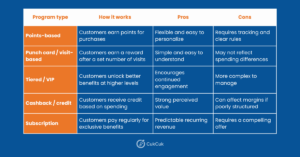
There is no single loyalty model that works for every restaurant. Your concept, average transaction value, customer frequency, and margins should determine which structure makes the most sense.
Points-Based Programs
Points-based loyalty is one of the most flexible approaches.
Example, you could give out one point for each ₱100 spent and reward customers with ₱100 once they reach a predetermined point total.
Your margins should determine the precise figures. Make the maths easy enough for customers to grasp how they can earn and redeem rewards right away.
Punch Card or Visit-Based Programs
This is an uncomplicated option for businesses such as cafés, bakeries, milk tea shops, and quick-service restaurants, for instance, a customer might receive a reward after their fifth or tenth qualifying purchase.
The advantage is simplicity, customers don’t have to understand a complicated points system. However, visit-based programs may be less suitable for restaurants where customer spending varies significantly from one visit to another.
Tiered or VIP Programs
Tiered programs give customers different benefits depending on their activity.
For example:
- Regular: Earn points on every purchase
- Silver: Receive birthday rewards and occasional exclusive offers
- Gold: Receive priority promotions or higher reward rates
Customers may be encouraged to continue spending in order to advance thru tiered programs. Benefits must, however, be significant enough to inspire patrons without going over budget for the eatery.
Cashback or Credit-Based Programs
Instead of awarding points, you can return a portion of a customer’s spending as restaurant credit.
For example, customers might receive ₱50 in credit after reaching a specific spending threshold.
This approach is easy to communicate because the reward has a clear peso value. Just make sure the redemption rules protect your profitability.
Subscription-Based Programs
Subscription loyalty programs ask customers to pay a regular fee in exchange for ongoing benefits.
Possible benefits include:
- Free beverages
- Exclusive menu items
- Member-only discounts
- Free delivery or ordering benefits
Subscription models work best when customers visit frequently enough to see consistent value.
Step-by-Step: How to Build Your Loyalty Program
Step 1 — Define Your Goals and Target Customers
Start with the behaviour you want to change. Do you want more people to come back? Increase the average order value? Bring back inactive clients? Boost traffic during the week?
Instead of attempting to solve everything at once, focus on one or two main objectives.
Next, decide which clients you wish to target. Rewards may have different effects on regular café patrons than on infrequent family diners.
Useful baseline metrics include:
- Repeat purchase rate
- Average transaction value
- Visits per customer
- Customer acquisition sources
- Promotion redemption rate
- Sales by customer segment
Without a baseline, it becomes difficult to determine whether your loyalty program is actually working.
Step 2 — Choose the Right Program Type for Your Concept
Match the program to your customers’ natural purchasing behavior.
A café with customers visiting several times a week may benefit from a simple visit or points system. A casual dining restaurant with larger but less frequent transactions may benefit from spending-based rewards.
Keep the customer journey in mind. If joining requires a lengthy registration process, customers may simply skip it.
Step 3 — Set the Reward Structure and Redemption Rules
Your rewards should be attractive without becoming a permanent discount on every transaction.
Consider:
- How customers earn rewards
- How many points or visits are required
- Minimum spending requirements
- Reward expiration
- Which products qualify
- Whether rewards can be combined with promotions
- When rewards can be redeemed
Aim for a balance between easy-to-understand rules and sustainable economics.
For example, a reward that requires six months of spending may feel unreachable. A reward that is too generous may encourage customers to wait for discounts instead of paying full price.
Step 4 — Pick the Right Technology or POS Integration
A loyalty program becomes much easier to manage when it is connected to your restaurant POS.
Instead of manually recording purchases, an integrated system can connect transactions with customer information and loyalty activity.
Look for a restaurant POS loyalty program that can support customer profiles, rewards, promotions, and reporting in the same workflow.
This also reduces the amount of manual work required from cashiers and servers.
Step 5 — Train Staff and Promote the Program
Even a well-designed loyalty program can fail if employees don’t know how to explain it.
Train staff to answer three basic questions:
- How does the customer join?
- How do they earn rewards?
- When can they redeem them?
Then promote the program at relevant customer touchpoints:
- Counter
- Receipt
- QR codes
- Website
- Social media
- Online ordering
- In-store signage
The objective is to make joining feel like a natural part of the customer experience rather than a sales pitch.
Step 6 — Track Performance and Iterate
Don’t launch the program and forget about it.
Track whether loyalty members actually behave differently from non-members.
Useful metrics include:
- Loyalty membership growth
- Repeat visit frequency
- Average order value
- Reward redemption rate
- Revenue from loyalty members
- Inactive member rate
- Promotion performance
- Customer retention
If customers are earning rewards but not returning more frequently, reconsider the incentive. If rewards are being redeemed too quickly, review the economics.
Your loyalty program should evolve based on customer behavior.
Must-Have Features to Look for in Loyalty Software
The right software can make a major difference in how easy your program is to operate.
POS Integration
Your loyalty system should connect with your POS so purchases, rewards, and customer activity can be tracked with minimal manual work.
A connected POS can also help your team apply promotions consistently at checkout.
Customer Data and Analytics
Customer data can help you understand purchasing patterns and identify opportunities for more relevant promotions.
Look for tools that let you analyze customer activity, sales performance, and campaign results.
Mobile and App Accessibility
Customers increasingly expect digital convenience. Depending on your concept, loyalty may work through an app, QR code, mobile-friendly account, digital receipt, or online ordering experience.
The important thing is to minimize friction.
Automated Promotions and Reminders
Automation can help you communicate with customers without requiring your team to manually contact every guest.
For example, you could use customer information to support birthday promotions, targeted campaigns, or re-engagement offers.
CUKCUK’s guest-engagement tools include personalized loyalty rewards, customizable tiers, automated tracking, referral benefits, promotional campaigns, and customer insights.
Common Restaurant Loyalty Program Mistakes to Avoid
A loyalty program can create value, but poor implementation can have the opposite effect.
Avoid these common mistakes:
- Overcomplicated rules: Customers should understand how to earn and redeem rewards quickly.
- Rewards that are too difficult to earn: If the first meaningful reward feels unreachable, customers may stop engaging.
- Rewards that are too generous: Excessive discounts can reduce profitability and train customers to wait for promotions.
- Poor staff buy-in: Employees need to understand the program and know how to introduce it naturally.
- No performance tracking: Without data, you cannot tell whether the program is increasing retention or simply rewarding customers who would have returned anyway.
- Ignoring customer experience: A loyalty program cannot fix poor food, service, or consistency.
- Too much friction: Requiring customers to complete lengthy forms or download an app before receiving value can discourage sign-ups.
- One reward for everyone: Different customer segments may respond better to different offers.
How CUKCUK Helps Restaurants Build Loyalty Programs
As your customer base expands, manually managing loyalty can quickly become challenging. This is where loyalty and regular operations can be linked by restaurant management software.
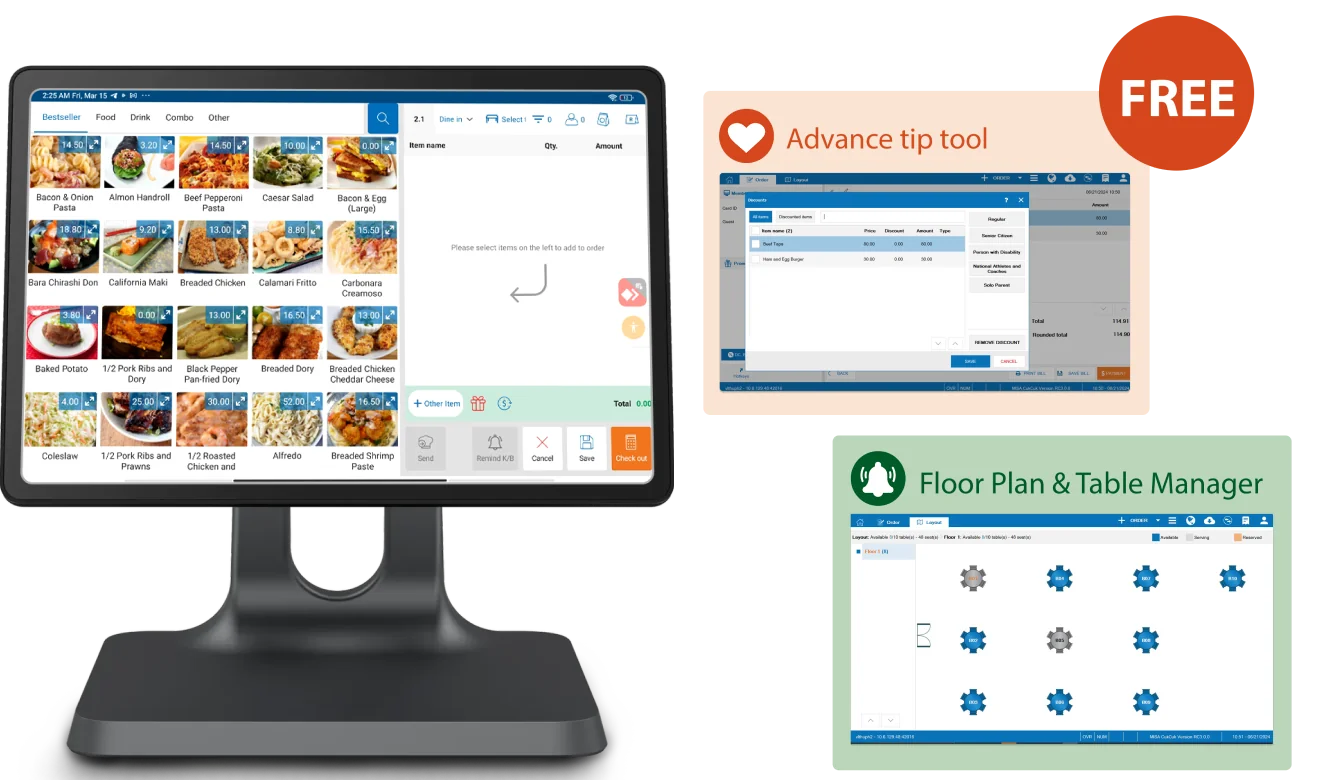
In order to assist restaurants in managing promotions, customer data, and loyalty activities from a single platform, CUKCUK integrates POS capabilities with guest-engagement tools. Personalised rewards, customer insights, milestone rewards, adjustable tiers, automated tracking, and referral benefits are all part of its guest-loyalty solution.
Promotional campaigns, such as item discounts, bill discounts, buy one, get one deals, giveaways, and multi-item promotions, are also supported by the platform.
For restaurants that allow online ordering, CUKCUK connects ordering with its loyalty program and guest data, creating another opportunity to encourage customers to return directly to the restaurant’s digital channel.
For multi-branch restaurants, centralized customer and loyalty management can be particularly useful. CUKCUK’s platform can support a unified customer database and loyalty across branches, allowing customers to earn points at one location and redeem them at another to encourage repeat visits while giving management better visibility into campaign performance.
For Philippine restaurant operators, this combination matters because loyalty shouldn’t exist separately from the rest of your operation. Your POS, customer data, promotions, ordering, and reporting should work together.
You can also learn more about CUKCUK’s guest engagement and loyalty solutions or explore its promotion management features.
Ready to turn more first-time diners into regular customers? Book a CUKCUK demo and see how an integrated restaurant POS can support your loyalty strategy.