

Choosing a POS system is a make-or-break operational decision for Philippine restaurant owners. The right POS platform can speed up service, reduce inventory errors, simplify BIR compliance, and give managers a clearer view of sales, while the wrong one can create extra work precisely when your team is busiest.
Two POS platforms worth comparing are CukCuk and StoreHub. CukCuk is built primarily around restaurant operations, with cloud access and offline functionality. On the other hand, StoreHub takes a broader all-in-one approach across F&B, retail, and service businesses.
So, the question is, which is better?
This article breaks down the two systems feature by feature, including offline operation, kitchen and table management, inventory, payments, loyalty, reporting, pricing, and BIR compliance, to help Philippine restaurant owners choose the right POS for their business and their needs.
CukCuk vs StoreHub at a Glance
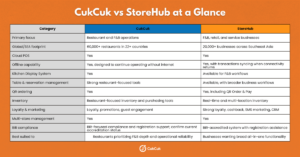
CukCuk serves more than 60,000 restaurants across 22+ countries, while StoreHub serves more than 20,000 restaurants, retailers, and service businesses using its platform across Southeast Asia.
In summary, CukCuk has the edge for restaurant-specific workflows, while StoreHub stands out for businesses that want one platform spanning F&B, retail, and service operations.
What Is CukCuk?
CukCuk is a cloud-based restaurant POS and management platform designed specifically for food businesses, which covers both front-of-house and back-of-house operations, including POS, table management, QR dine-in, tablet ordering, reservations, kitchen display, payments, inventory, and reporting.
One of CukCuk’s unique features is its offline capability. CukCuk POS allows businesses to continue operating offline across devices, which can be particularly useful for Philippine restaurants dealing with unstable internet connections. Once connectivity is restored, cloud-based data can continue to support centralized management.
CukCuk also offers a free Basic POS plan with core POS, menu management, and reporting features. Paid tiers add capabilities such as advanced inventory, QR dine-in, online ordering, reservations, KDS, restaurant-chain management, and other advanced functions. At the moment, the plans start at ₱1,395 per month for Standard packages, ₱2,750 for Professional packages, and ₱3,995 for Enterprises, excluding wavlue added tax (VAT).
What Is StoreHub?
StoreHub positions itself as an all-in-one POS platform for F&B, retail, and service businesses, and this positioning is important when comparing the two. This is due to the fact that StoreHub is not limited to restaurants, so its feature set is designed to support different business models from a single platform.
For restaurants, StoreHub provides POS, inventory, employee management, QR Order & Pay, loyalty, marketing, e-commerce, reporting, and multi-location management, while also supporting online and offline selling, allowing businesses to continue processing transactions when the internet is unavailable and sync data afterward.
StoreHub is also a BIR-accredited company in the Philippines, where its current BIR documentation states that the system generates Z-readings, X-readings, and e-journals and provides support for the registration process.
A Feature-by-Feature Comparison of CukCuk and StoreHub
1. Offline Functionality
For restaurants, internet reliability is not a minor technical consideration. A connection failure during lunch or dinner service can quickly turn into slower ordering, frustrated customers, and longer queues.
CukCuk makes offline operation a prominent part of its product positioning. The company says its POS continues to work offline across devices, allowing restaurant teams to keep operating even when connectivity drops.
StoreHub also supports offline transactions. Its Philippine BIR page specifically states that businesses can keep selling offline and synchronize transactions when they are back online.Takeaway: Both can handle offline selling, but CukCuk gets the nod if offline-first restaurant operation is one of your primary buying criteria.
2. Kitchen & Table Management
This is where a restaurant-specific POS can have a meaningful advantage.
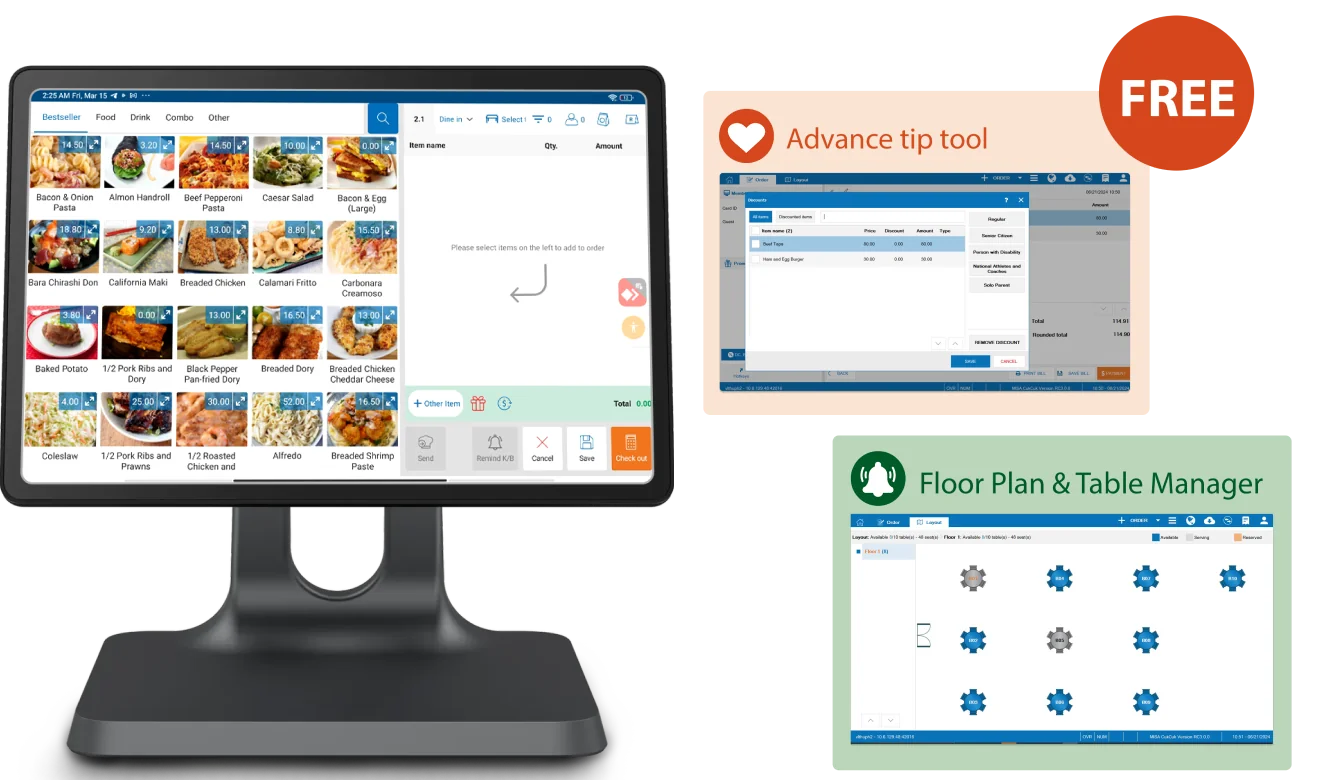
CukCuk offers table selection, table changes and combinations, split orders, reservation management, tablet ordering, QR dine-in, and a Kitchen Display System. Its platform is designed to connect front-of-house orders with kitchen operations and table service. StoreHub also supports F&B workflows, including QR Order & Pay, order management, reservations, and restaurant operations. Its advantage is that these tools sit inside a wider business platform rather than a restaurant-only ecosystem.
All in all, it is evident that CukCuk is the stronger choice for restaurants where tables, modifiers, kitchen workflows, and service speed are central to daily operations.
3. Inventory Management
Inventory management can directly affect restaurant margins because inaccurate stock counts lead to waste, shortages, and unexpected purchasing.
CukCuk provides restaurant-focused inventory tools covering ingredient control, purchasing, stock recording, live inventory reporting, alerts, and multi-stock handling. Its higher-tier plans also add advanced inventory and purchasing management.
StoreHub offers real-time inventory management, advanced inventory on higher plans, stock transfers, and stock alerts. Its platform is designed to support inventory across multiple locations.
In conclusion, CukCuk has an advantage for ingredient-heavy restaurant operations, while StoreHub shines when inventory needs to span different business types or multiple outlets.
4. Multi-Store & Franchise Management
Both systems can scale beyond a single restaurant.
CukCuk’s Enterprise plan includes multi-store management and restaurant-chain management, while its platform is specifically marketed to franchises and multi-branch restaurants. Centralized reporting helps owners monitor operations beyond the individual cashier terminal.
StoreHub also supports multi-location management, centralized reporting, advanced inventory, and stock transfers. Its current plans position Advanced for multi-location businesses and Pro for larger brands requiring deeper integrations and workflow automation.
Both brands are suitable for growing chains, specifically, CukCuk is particularly great for restaurant franchises, while StoreHub offers strong compatibility for mixed-format businesses.
5. Online Ordering, QR & Delivery Integrations
In the modern era of e-commerce, digital ordering is now an integral part of restaurant POS selection.
For example, CukCuk provides QR dine-in, online ordering, tablet ordering, and an online ordering website. Its online ordering solution is designed to connect orders with the restaurant’s existing menu and operations, while the company also highlights third-party delivery integrations.
Whereas StoreHub offers QR Order & Pay, e-commerce capabilities, online selling, and food-delivery functionality, making it useful for businesses that want to connect physical stores with online sales.
As an advice, owners can choose CukCuk for restaurant-centric ordering workflows, but if you want physical and online commerce managed within a broader all-in-one platform, then StoreHub can be your choice.
6. Payments & QR Support in the Philippines
Payments are also becoming more diverse in the modern restaurant world, where restaurants are accepting payments via QR codes as well aside from cash and cards.
For this, CukCuk supports cash, card, and QR payments, and its payment materials specifically reference e-wallets like GCash and Maya.
StoreHub also provides integrated payments and QR Order & Pay, where its Philippine offering is built around integrated transactions and BIR-compliant payment workflows.
So to say, both support modern Philippine payment expectations like confirming the exact payment processor, e-wallet, terminal, and transaction-fee setup available for your business before signing up, making them both suitable choices for modern Filipino restaurants.
7. Customer Loyalty & Marketing Tools
If your restaurant depends on repeat customers, POS software can become a marketing platform as well as a cash register.
To support this, CukCuk offers loyalty and guest-engagement features alongside promotions, online ordering, and customer data. Its online ordering platform specifically highlights loyalty and guest insights.
Meanwhile, StoreHub has a particularly strong focus on customer retention, including built-in loyalty and membership, cashback, customer databases, and automated SMS marketing in its platform.
8. Staff Management
Restaurant POS software increasingly needs to manage employees as well as transactions.
CukCuk offers employee management within its restaurant management platform, with tools designed to help managers monitor and organize staff operations.
StoreHub also provides employee management connected to its POS, helping businesses manage staff productivity and employee-related workflows from the same system.
Both POS Solutions cover core staff management; the better choice depends on which platform fits your existing scheduling, payroll, permissions, and HR processes.
9. Reporting & Analytics
The value of a cloud POS extends beyond taking orders as owners need to know what is selling, which branches are performing, and where costs are increasing.
To answer this, CukCuk provides real-time sales reporting, activity dashboards, purchase and inventory reporting, cash-flow information, and restaurant-chain management on applicable plans.
On the other hand, StoreHub provides real-time insights, reporting, multi-store visibility, inventory analytics, and sales information through its BackOffice environment. Advanced and Pro plans add deeper reporting capabilities.
This positions both POS systems as strong platforms for analytics, where CukCuk is particularly suited to restaurant operations, while StoreHub’s reporting works well for broader multi-business environments.
10. BIR Compliance
BIR compliance should be treated as a non-negotiable when choosing a POS in the Philippines.
StoreHub explicitly states that its POS is BIR-accredited and that it generates required reports such as Z-readings, X-readings, and e-journals. It also offers assistance with BIR registration and says its system is updated as requirements change.
CukCuk also places significant emphasis on BIR compliance. Its Philippine materials describe support for BIR registration, compliant receipt generation, VAT and Senior Citizen/PWD discount calculations, X- and Z-readings, and eSales reporting. Its accreditation page also describes the platform as designed to help Philippine restaurants remain compliant.
Because BIR requirements and registration status can change, restaurant owners should verify the current accreditation/registration documentation for the exact POS setup they intend to deploy before purchasing.
CukCuk vs StoreHub Pricing
Price is one of the biggest differences for a small restaurant evaluating a POS, especially for those who are only starting out in the industry.
CukCuk offers a free Basic POS plan with core POS, menu management, and reporting. Its published paid plans currently include Standard at ₱1,395/month, Professional at ₱2,750/month, and Enterprise at ₱3,995/month, excluding VAT. Features increase with each tier, including advanced inventory, QR dine-in, online ordering, KDS, reservations, and multi-store management.
StoreHub’s current Philippine pricing starts at ₱2,249/month for Starter, ₱4,499/month for Advanced, and ₱8,999/month for Pro. Advanced adds multi-location management, advanced inventory, reporting, stock transfers, and alerts, while Pro adds features such as API access, workflow automation, and dedicated support.
Hardware, payment processing, implementation, and registration-related costs can affect the total cost of ownership for either POS.
Take note that POS pricing and inclusions change over time. Treat the figures above as a current reference point, then confirm the latest software, hardware, payment, and onboarding costs directly with each provider.
Which One Should You Choose?
The best POS system in the Philippines depends less on which company has the longest feature list and more on how your restaurant actually operates.
Choose CukCuk if:
- You run a restaurant, café, QSR, or other F&B operation.
- Kitchen and table management are central to your workflow.
- You want strong restaurant-specific tools such as KDS, reservations, QR dine-in, and tablet ordering.
- Offline reliability is a major concern.
- You want to start with a free Basic POS and upgrade as your operation grows.
- You expect to expand into multiple restaurant branches or franchises.
Choose StoreHub if:
- You operate across F&B, retail, or service businesses.
- You want one platform for multiple business formats.
- Loyalty, cashback, CRM, and SMS marketing are high priorities.
- You need strong multi-location inventory and reporting.
- You value an explicitly BIR-accredited system with registration assistance.
- You want a broader all-in-one commerce platform connecting physical and online sales.
A Simple Decision Rule
- Restaurant-first business → CukCuk
- Restaurant + retail/service or marketing-heavy operation → StoreHub
- Offline restaurant reliability + kitchen workflows → CukCuk
- Loyalty + cashback + broader business versatility → StoreHub
Final Notes about CukCuk and StoreHub

There is no universal winner in the CukCuk vs StoreHub comparison.
CukCuk’s biggest advantage is F&B depth due to how its platform is designed around restaurant realities, from tables and reservations to kitchen displays, menu management, QR ordering, inventory, and offline operation. Its free Basic plan also makes it easier for smaller restaurants to start without a large software commitment.
StoreHub’s biggest advantage is its versatility. It combines POS, inventory, payments, loyalty, marketing, e-commerce, employee management, and multi-location capabilities in a platform built for F&B, retail, and service businesses, and its Philippine offering also has a clearly stated BIR-accredited position and registration support.
For a restaurant owner whose biggest concerns are kitchen efficiency, table service, offline reliability, and restaurant-specific workflows, CukCuk is the stronger fit. Meanwhile, for an operator who wants a broader commerce platform with strong loyalty and marketing tools (or manages different types of businesses), StoreHub may be the better choice for them.
Before committing and investing on a POS Platform, it’s important to compare the exact features, integrations, hardware, payment rates, BIR requirements, and total monthly cost for your outlet configuration.
Ready to see whether CukCuk fits your restaurant? Book a free CukCuk demo or start with the free Basic POS plan and evaluate the workflow with your own team.